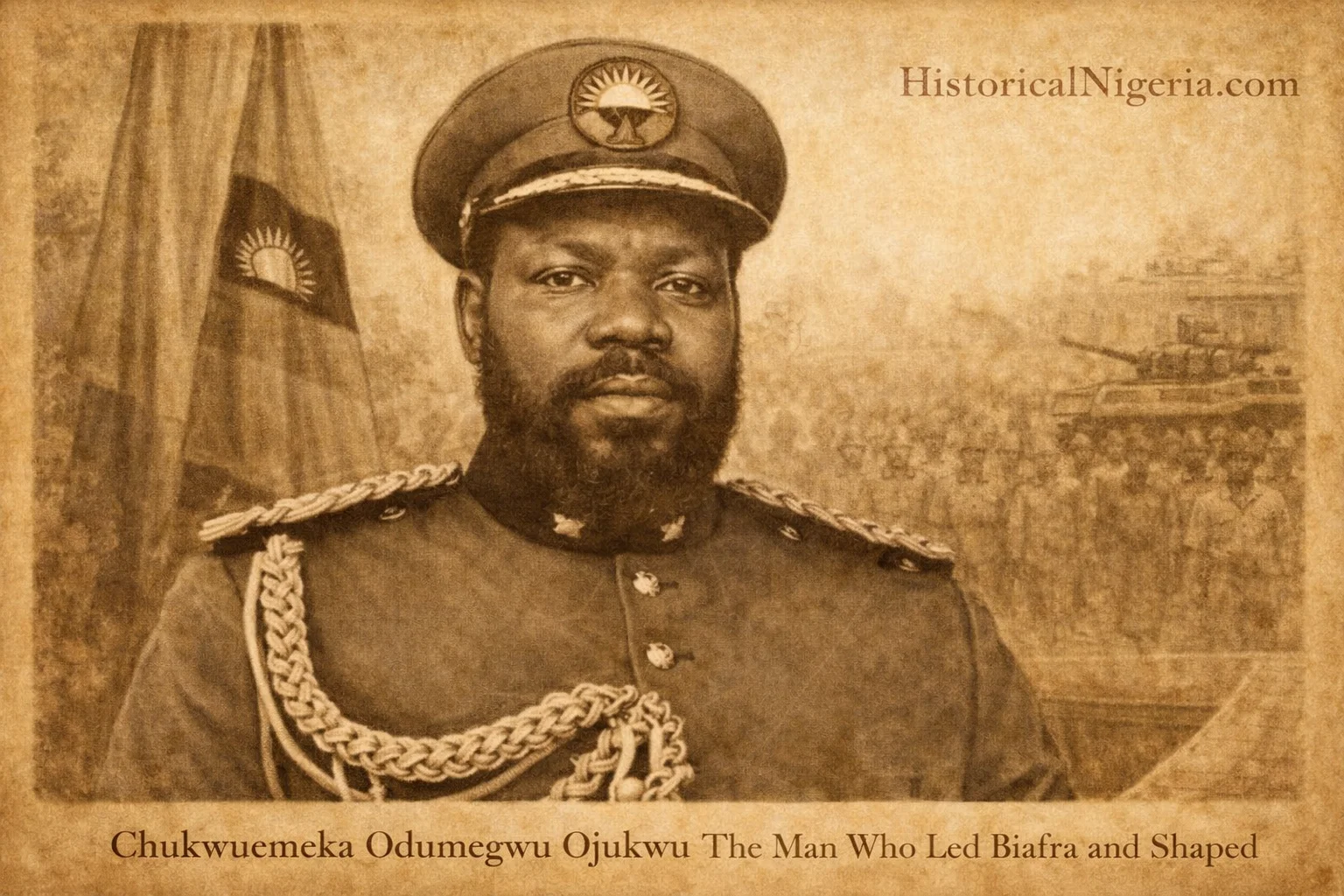
Early Life and Education
Chukwuemeka Odumegwu Ojukwu was born on November 4, 1933, in Zungeru, Northern Nigeria, to Sir Louis Odumegwu Ojukwu, one of the wealthiest Nigerian businessmen of his time. The Ojukwu family originated from Nnewi, Anambra State, but their influence and activities extended throughout Eastern Nigeria, including Enugu, which served as the commercial and administrative hub of the region.
Young Ojukwu grew up in privilege, attending some of the best schools in Nigeria. He studied at King's College in Lagos before traveling to the United Kingdom in 1949. He initially studied at Epsom College and later at Lincoln College, Oxford University, where he earned a master's degree in Modern History. At Oxford, Ojukwu distinguished himself as an exceptional student and a gifted orator.
Upon returning to Nigeria in 1956, Ojukwu joined the Nigerian civil service as an administrative officer working in the Eastern Region. His intelligence and leadership qualities quickly became apparent, and he rose through the ranks. In 1957, he transferred to the Nigerian Army, becoming one of the first university graduates to join the military.
Military Career and the January 1966 Coup
Ojukwu trained at the Royal Military Academy Sandhurst and at the Infantry School in Warminster, England. He returned to Nigeria as a captain and served in various capacities, including commanding a battalion in the Congo peacekeeping mission. By 1964, he had risen to the rank of lieutenant colonel and was commanding the Fifth Battalion in Kano.
The January 15, 1966 military coup, led primarily by Igbo officers, dramatically altered Nigeria's political landscape. The coup resulted in the deaths of several northern politicians and senior military officers. In its aftermath, General Johnson Aguiyi-Ironsi, an Igbo officer, became Head of State. Ojukwu was appointed military governor of the Eastern Region, with his headquarters in Enugu.
When a counter-coup in July 1966 brought General Yakubu Gowon to power and led to widespread massacres of Igbo people in the north, Ojukwu refused to recognize Gowon's authority. Hundreds of thousands of Igbo survivors fled to the Eastern Region, seeking safety. Enugu became the center of a humanitarian crisis as the city swelled with refugees.
The Declaration of Biafra
After months of failed negotiations, Ojukwu declared the independence of the Republic of Biafra on May 30, 1967, from his headquarters in Enugu. The new state comprised the Eastern Region of Nigeria, and Enugu was designated as its capital. In a historic radio broadcast, Ojukwu proclaimed that Biafra would be a land of freedom, justice, and opportunity for all its citizens.
Enugu became the heartbeat of the Biafran nation. Government buildings housed the new administration, and the city's infrastructure was repurposed for the war effort. Ojukwu's leadership during this period was characterized by strategic military decisions and powerful oratory that rallied the Biafran people. His speeches, broadcast from Enugu, inspired fierce resistance against the federal forces.
The Nigerian civil war began in July 1967. Federal troops captured Enugu in October 1967, forcing the Biafran government to relocate first to Umuahia and later to Owerri. Despite losing the capital, Ojukwu continued to lead the Biafran resistance for another two and a half years.
Legacy and Connection to Enugu
After the war ended in January 1970, Ojukwu went into exile in Ivory Coast, where he was granted asylum by President Félix Houphouët-Boigny. He remained in exile for 13 years before returning to Nigeria in 1982 after receiving a pardon from President Shehu Shagari. He re-entered politics and ran for president in 2003 and 2007 under the All Progressives Grand Alliance (APGA).
Dim Chukwuemeka Odumegwu Ojukwu passed away on November 26, 2011, in London. He was given a state burial and was laid to rest in his hometown of Nnewi. His legacy remains deeply intertwined with the history of Enugu. As the capital of Biafra, Enugu carries the memory of the secessionist dream and the resilience of the Igbo people.
Ojukwu is remembered as a brilliant strategist, a courageous leader, and a symbol of Igbo determination. His statues in Enugu and across Eastern Nigeria stand as reminders of a leader who, in the face of overwhelming odds, chose to stand with his people. The title "Dim" — meaning "Great One" in Igbo — reflects the enduring respect and admiration he commands.