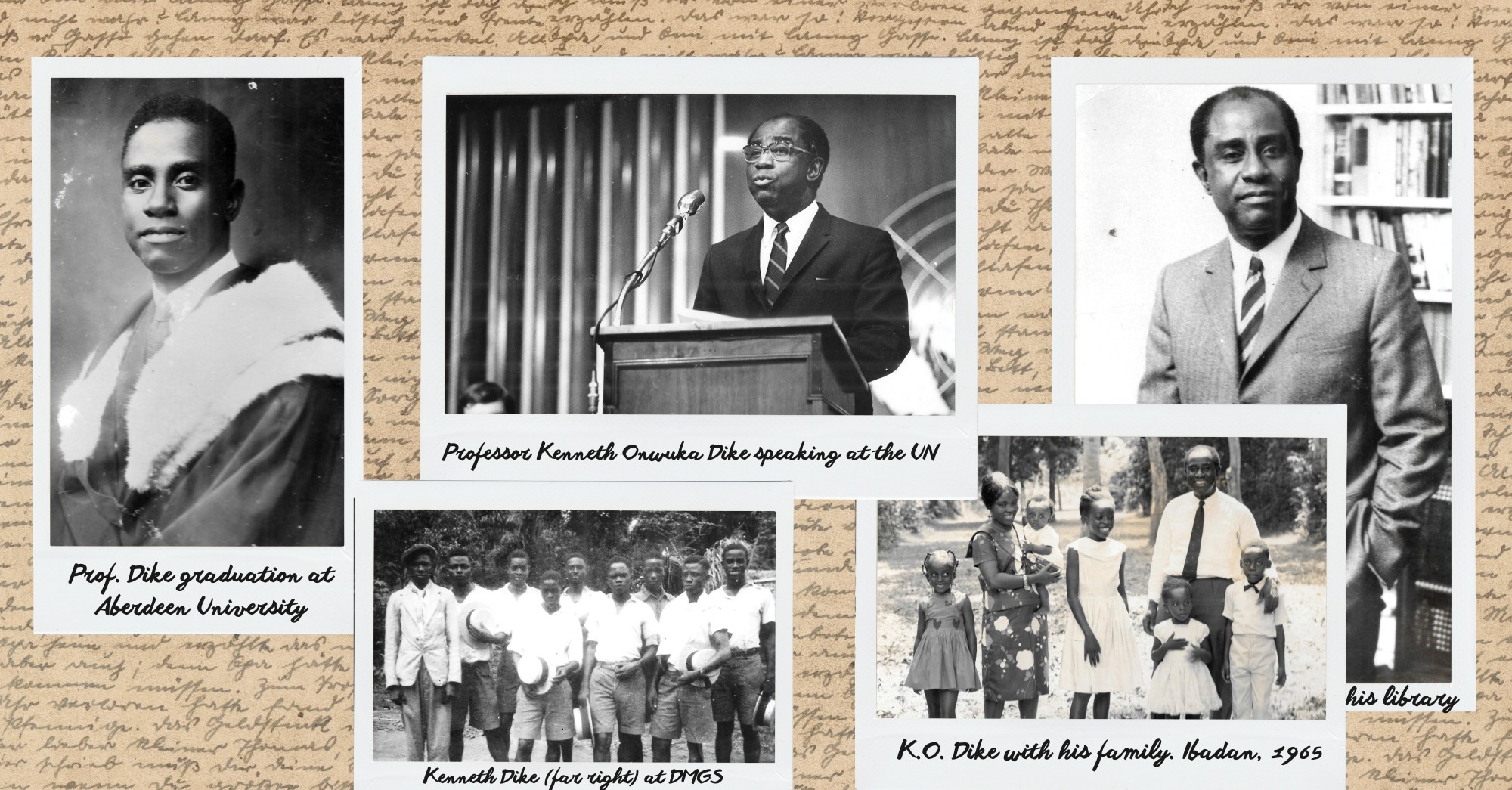
Early Life and Education
Kenneth Onwuka Dike was born on December 17, 1917, in Awka, Anambra State, but his life and career are closely linked to Enugu, the capital city that served as the intellectual and administrative center of Eastern Nigeria during his formative years. Growing up in the colonial era, Dike witnessed firsthand the impact of British rule on Igbo society, an experience that shaped his academic interests.
Dike attended Dennis Memorial Grammar School in Onitsha and later Government College in Ibadan, where he excelled in his studies. His academic brilliance earned him a scholarship to study at Fourah Bay College in Sierra Leone, then affiliated with Durham University. He graduated with a bachelor's degree in English and History in 1939.
After teaching briefly in Nigeria, Dike traveled to the United Kingdom in 1947 to pursue graduate studies at the University of Aberdeen in Scotland, where he earned a master's degree. He then moved to King's College London, where he completed his Ph.D. in 1950, becoming one of the first Nigerians to earn a doctorate in history.
Groundbreaking Historical Work
Dike's doctoral dissertation, "Trade and Politics in the Niger Delta, 1830-1885," was a revolutionary work that challenged the prevailing Eurocentric narratives of African history. Published as a book in 1956, it demonstrated that African societies had complex political and economic systems long before European contact. Dike argued that Africans were active agents in their own history, not passive recipients of European influence.
His work was particularly significant for the study of the Niger Delta and coastal regions of what is now Eastern Nigeria, including areas closely connected to Enugu's trade networks. Dike's research highlighted the sophisticated trading systems, diplomatic relations, and political organizations that existed in pre-colonial Igbo and Delta societies.
Dike is widely regarded as the father of modern African historiography. He pioneered the use of oral traditions, indigenous sources, and African perspectives in historical research, methodologies that transformed how African history was studied and taught worldwide. His approach influenced an entire generation of African historians.
Academic Leadership at University of Ibadan
After completing his Ph.D., Dike returned to Nigeria and joined the University of Ibadan, which had been established in 1948 as a college of the University of London. He rose quickly through the academic ranks, becoming a professor and the head of the History Department. In 1960, he made history by becoming the first Nigerian Vice-Chancellor of the University of Ibadan, a position he held until 1967.
As Vice-Chancellor, Dike transformed Ibadan into one of Africa's premier universities. He established the Institute of African Studies, which became a center for research on African history, languages, and cultures. He also founded the Ibadan History Series, a collection of scholarly works that remains influential in African historical studies.
During his tenure, Dike mentored numerous Nigerian historians who went on to establish history departments across the country, including at the University of Nigeria, Nsukka, near Enugu. His influence on history education in Enugu State and across Nigeria is profound.
Connection to Enugu and Later Career
Dike's connection to Enugu strengthened during the Nigerian Civil War (1967-1970), when he served as an adviser to the Biafran government. Like many Igbo intellectuals, he found himself in Enugu during the early months of the war, contributing his expertise to the Biafran cause. After the war, he worked to rebuild academic institutions in Eastern Nigeria.
He later served as a visiting professor at Harvard University and held positions at other prestigious institutions in the United States. Despite his international career, Dike maintained close ties to his roots in Eastern Nigeria and regularly contributed to scholarly and cultural initiatives in the region.
Kenneth Dike passed away on October 26, 1983, but his legacy endures. The Kenneth Dike Library at the University of Ibadan stands as a monument to his contributions to Nigerian education. His methodologies and approaches continue to shape the study of African history at universities in Enugu State and across the continent. He is remembered as a pioneer who gave Africa back its history — a profound gift to the people of Enugu State and all of Africa.